Care and use
Artificial Grass and Heat in Morocco: What Really Works
It’s the first objection we hear, and it’s a fair one: artificial grass does get hotter than a natural lawn. Better to say it plainly than dodge it, because the issue is easy to manage as long as it’s addressed at the design stage rather than after the fact.
Why it heats up
A natural lawn cools itself through evapotranspiration: it releases water vapour, and that change of state absorbs heat. It’s a biological air conditioner, and that’s exactly what makes it thirsty for water.
Artificial grass has no such mechanism. Its polymer fibres absorb radiation and give it back out. Under a Moroccan summer sun, in the middle of the afternoon and with no shade, the surface can become unpleasant to walk on barefoot. It’s not a manufacturing flaw, it’s physics.
What actually changes the temperature
Fibre colour and sheen
Dark, heavily saturated tones absorb more. Newer ranges use fibres with increased reflectivity and blends of lighter tones, which shave off several degrees without looking artificial.
The infill
On a sports pitch, the type of infill matters as much as the fibre. Black rubber granulate stores heat; silica sand and lighter infills much less so. On infill-free ranges, this factor disappears entirely.
The underlay
A bare concrete slab stores heat and radiates it back into the grass all evening. A draining, ventilated base stays noticeably cooler and drops back down faster once the sun goes down.
Shade, by far the strongest lever
This is the point that’s consistently underrated. A pergola, a shade sail or simply a well-placed tree changes the outcome more than any product option ever will. A shaded surface stays comfortable even in August.
What actually works
- Hose it down for a few minutes. A quick spray drops the temperature immediately. The effect lasts one to two hours, and the water used is nowhere near what a real lawn needs.
- Stagger use. The peak falls between 1pm and 4pm. Morning and late afternoon are no problem at all, which matches the hours people actually use the space anyway.
- Plan shade in from the design stage, not once the site is finished.
- Choose the right range if the area is exposed and meant for bare feet, around a pool for example.
The case of sports pitches
On a football pitch or a padel court, players wear shoes and bookings cluster in the late afternoon or under floodlights. Temperature becomes secondary next to bounce consistency and footing stability, which are the criteria FIFA certifications actually test.
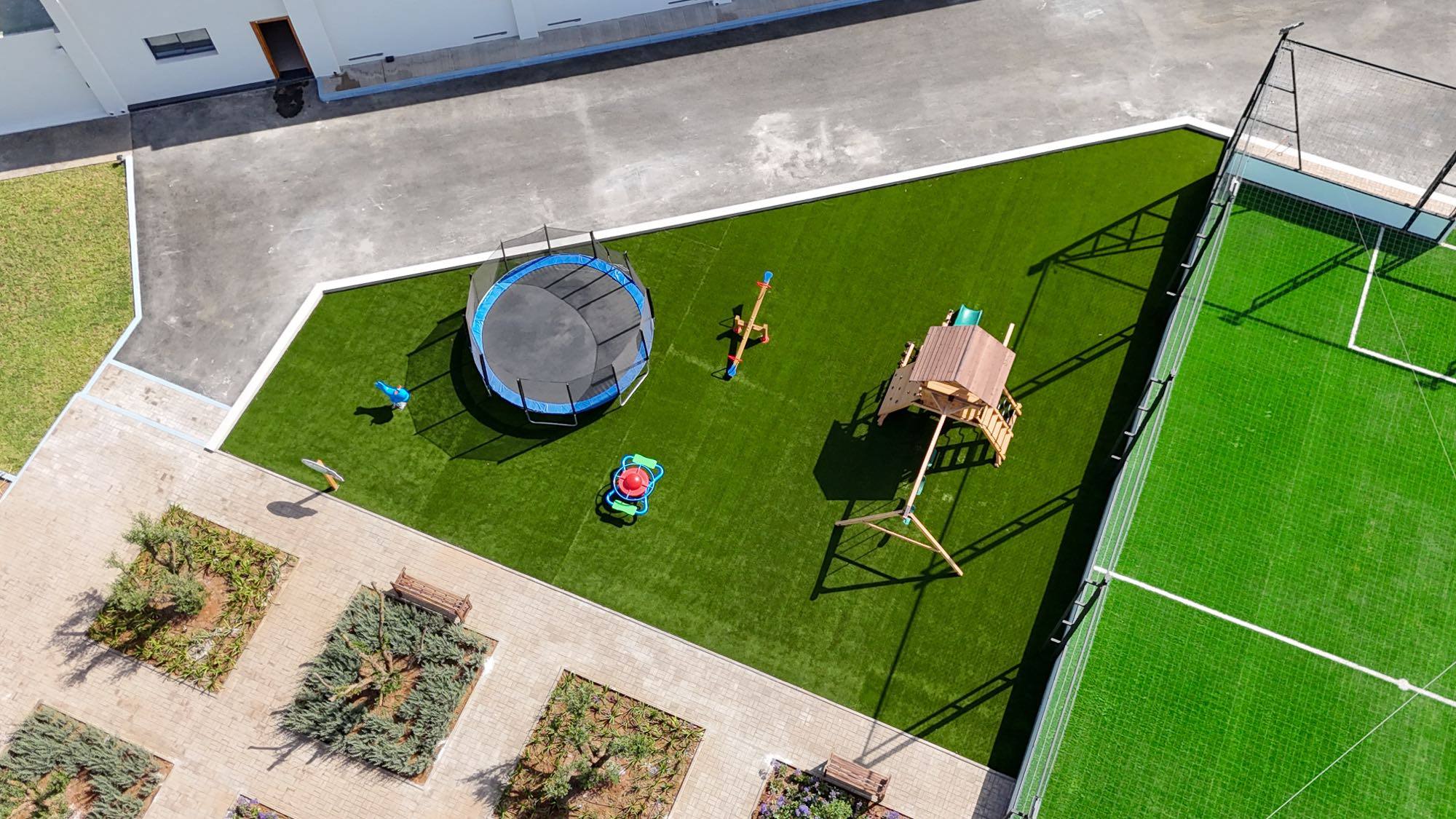
For school projects, on the other hand, where children sometimes run around barefoot, shading the play areas is as much a design requirement as the shock-absorbing surface.
Is that a reason to give up on it?
No, but the trade-off needs to be made with eyes open. A natural lawn does stay cooler: that’s its real advantage, and we say so in our synthetic versus natural comparison. Against that, it uses between 1,500 and 2,000 litres per square metre a year, a hard figure to justify in a water-stressed country, and it still yellows in high summer regardless.
The right approach is zone by zone: synthetic grass where people walk and play, shade above it, and hard landscaping on walkways. That’s the approach we set out in our article on designing a garden without irrigation.
In practice
In Marrakech as in Agadir, we always start from the site’s actual sun exposure before recommending a range. Our Casablanca showroom lets you compare fibres in person, and the site visit is free.