Playgrounds and safety
Playground Artificial Grass: Safety & EN 1177 Standard
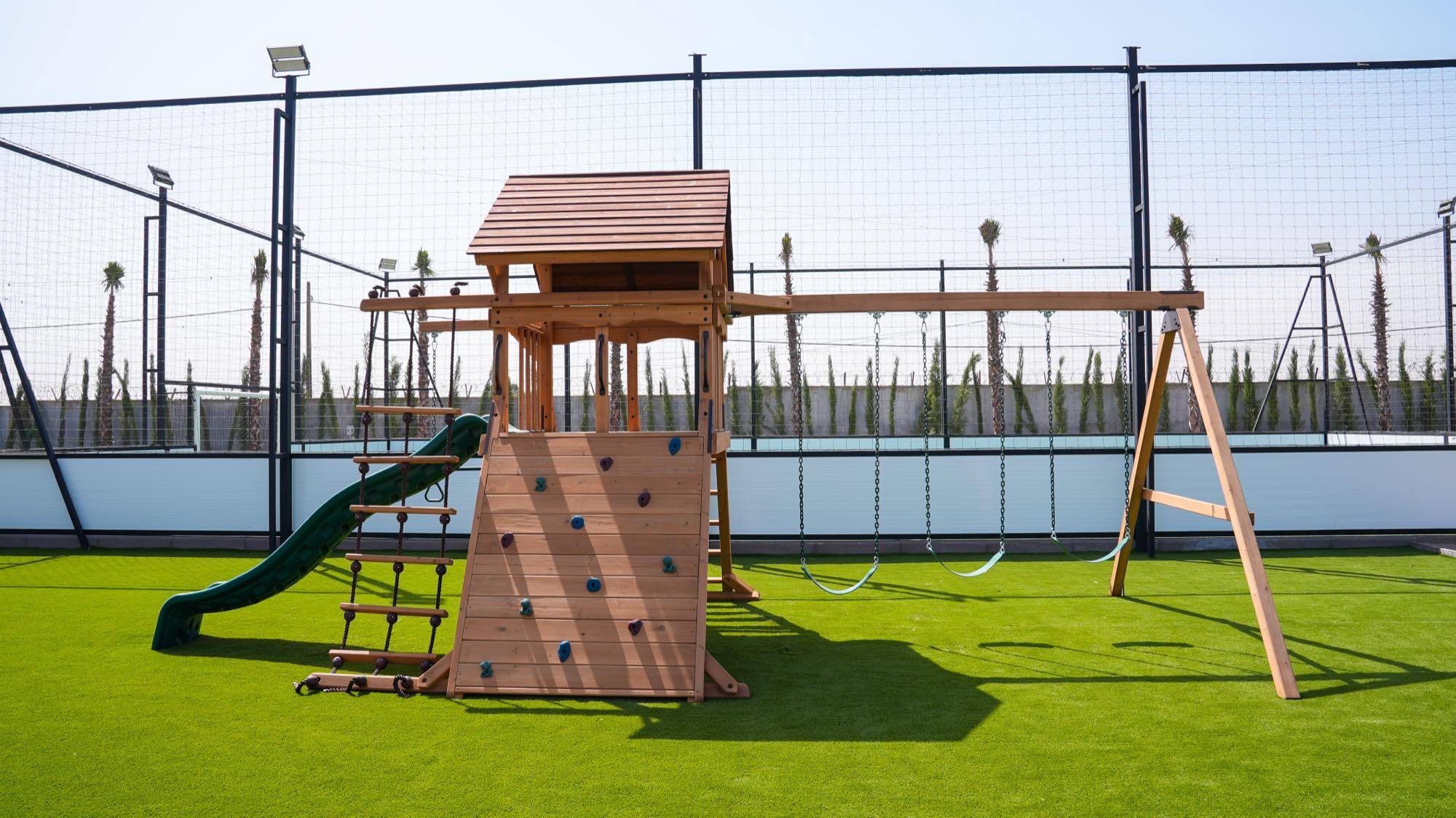
On a playground, the ground is not decoration. It determines what happens when a child falls from a slide or a climbing frame. It is also what puts the liability on the client, whether that is a school, a local authority, a residents’ association or a hotel.
The rule is written down: it’s the EN 1177 standard.
What the EN 1177 standard actually says
The standard links two things: the free fall height of each piece of equipment and the shock-absorbing capacity of the surface installed underneath. It defines a HIC (Head Injury Criterion), measured in a laboratory, which sets the thickness a given surface needs to protect up to a given height.
Two practical consequences that get underestimated:
- The calculation is done structure by structure. A 2.50 m climbing frame and a 60 cm spring rocker do not call for the same thickness.
- The zone that needs protecting extends beyond the footprint of the equipment: it covers the whole impact area around it.
Grass alone is not enough
This is the most common misunderstanding. Artificial grass laid directly on a concrete slab absorbs almost nothing, whatever the pile height. What actually absorbs impact is the underlay beneath it, usually shock pads or a cushioning layer whose thickness is chosen for the highest fall height on site.
The grass provides the look, the comfort and the cleanliness; the underlay provides the safety. The two are sized together, not separately.
Why synthetic rather than sand or wood chips
Loose-fill surfaces stay compliant as long as they are kept at a constant thickness, but that is exactly where it falls apart. Sand and wood chips shift, get scooped out under swings and at landing points, and need regular raking and topping up. An unmaintained playground drifts out of compliance without anyone noticing.
A grass-plus-underlay system keeps its thickness over time. It also avoids dust, a real issue in school playgrounds, and does not hide litter or insects.
Other safety points
- Temperature. Under direct Moroccan sun, a dark surface heats up. Planning shade over play areas matters as much as the choice of surface.
- Fire behaviour. On a site open to the public, the grass’s fire reaction classification, typically Cfl-s1, is part of the file.
- Drainage. An impact area that holds water becomes slippery and degrades quickly.
- Finishing. Seams and edges must be sealed: a joint that opens becomes a trip hazard.
What to ask your supplier for
Three documents, and they should be provided without argument:
- The grass technical data sheet, with fibre type, density and fire classification.
- The EN 1177 test report for the underlay, stating the fall height covered for the thickness specified.
- The layout plan showing the impact area of each structure.
A supplier who cannot produce the second document is not selling a compliant playground.
How we work
Proturf supplies the grass, the shock-absorbing surfaces and the play structures, with the corresponding technical data sheets, and puts you in touch with a partner installer trained on these ranges. The underlay thickness is always sized from the equipment actually installed, not a standard figure.
For a school, municipal or residential project, the site visit and measurement are free: request a quote.